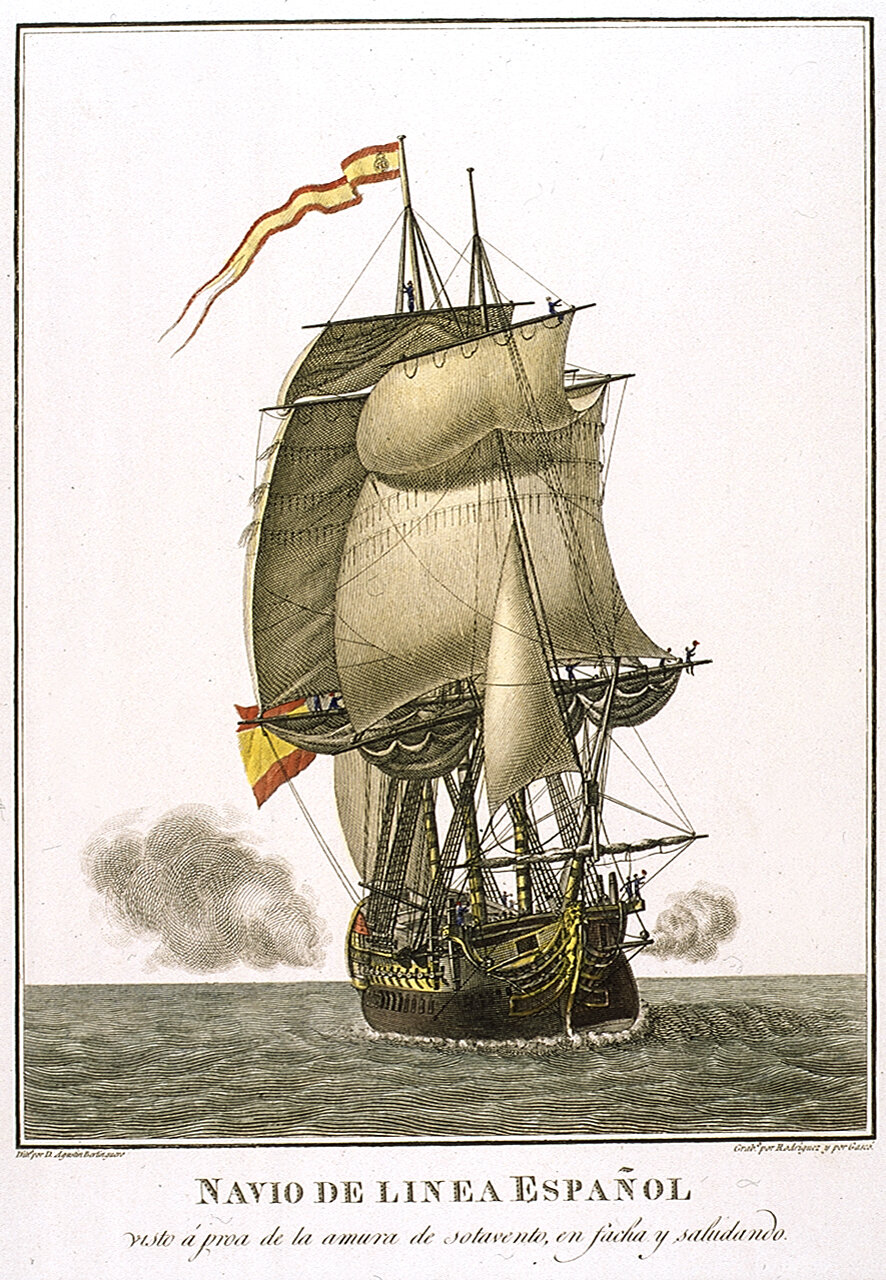
the mediterranean privateering and. the mediterranean privateering and.
Relacionado: The ship San Ildefonso: a 74-gun ship of the Spanish Navy
the mediterranean privateering and.
the mediterranean privateering and.
The royal patent as a border between privateering and piracy
In the Mediterranean of the 18th century, the line between naval warfare and plunder was thin, but there was a legal criterion that precisely delimited it: the patent of marque. A privateer operated under the express authorization of a sovereign and was governed by the right of prizes; a pirate, on the other hand, acted on his own account, without a legitimate flag to protect his actions. This distinction was not a theoretical nuance: it determined how captures were judged, how loot was distributed, and what diplomatic protection each crew could assert in court.
The legal framework of privateering in the Hispanic Monarchy
The institution of privateering allowed the Crown to mobilize private vessels for economic warfare against enemy powers without bearing the full cost of maintaining a permanent fleet. The sovereign issued the patent, established the conditions of the prizes and supervised the distributions through the marquee courts. In the Spanish Mediterranean, this practice operated for decades as a defensive and offensive system at the same time: corsairs protected coastal trade while harassing the ships of Algiers and other Barbary regents.
British documentation on its own privateers provides a useful comparative framework. The UK National Archives describe the phenomenon in analogous terms:privateers—the English term for privateers—were owners of armed vessels with a state license, authorized to capture enemy ships during times of war. The substantial difference with respect to piracy was precisely that prior authorization, without which the activity was considered a common crime. The Spanish privateering of the 18th century responded to the same legal principle.
Antonio Barceló: from the Mallorcan xebek to the royal navy
The figure that connects the world of Balearic privateering with the Royal Navy is Antonio Barceló y Pont de la Terra. Born in Palma de Mallorca in 1717, this sailor embodied the transition from traditional privateering practices to regular naval warfare. His origin was neither noble nor academic: he came from the Mallorcan seafaring environment, familiar with xebecs, those fast and maneuverable boats typical of the Balearic Corsican that demonstrated their effectiveness both in capturing prey and in coastal surveillance.
The xebeks: a Mediterranean naval school
The xebec was a boat of Mediterranean origin, with a lateen sail and a slender hull, designed for speed and navigation in shallow waters. Its small crew and its ability to stealthily approach the coast made it an ideal instrument for privateering. The experience accumulated by the sailors who operated these ships constituted a fund of tactical knowledge that the Navy could not ignore. Barceló knew how to capitalize on that experience: he rose from the world of Majorcan privateering to command positions in the Royal Navy, integrating the tactics of the Xebecs in the campaigns against the corsairs of Algiers.
Barceló’s rise was not an isolated case of individual merit. It reflected a structural reality: the Monarchy needed experienced seamen and found them in the Mediterranean ports where privateering had been practiced for generations. The navigation knowledge, coastal surveillance systems and information networks developed by the Balearic privateers were thus transferred to royal service.
The campaigns against Algiers and the peace of 1786
Barceló’s career reached its climax in the Algiers bombing campaigns of 1783 and 1784. These military operations, directed against the main base of Barbary corsair activity in the western Mediterranean, represented the Spanish Monarchy’s most ambitious effort to neutralize the Algerian threat. After these bombings, peace was signed with Algiers on June 14, 1786, an event that closed the Spanish-Algerian war cycle of the 18th century.
That date of 1786 functions as a natural chronological limit for any analysis of the privateering against Algiers. After the signing of peace, the letters of marque against the Algerian regency lost their immediate justification, and Spanish privateering activity in the Mediterranean was reoriented or declined. The privateer, ultimately, was an instrument of war: when peace came, it lost its reason for being.
The documentary cartography of the Corsican: where is the data
If the figure of Barceló provides the biographical anchor of the Spanish Corsican of the 18th century, the quantitative evidence remains dispersed in archives. Queries made in digitized sources do not yet return complete series of issued patents, captured prey or paid ransoms. This does not mean that such data do not exist: it means that they remain in documentary collections whose direct consultation is essential for any numerical assertion.
The funds of Simancas and the Secretary of the Navy
The General Archive of Simancas preserves the collection of the Secretary of the Navy, where the privateering and registration files should be located. This archive, the documentary headquarters of the Hispanic monarchy since the 16th century, houses the administrative documentation that the Crown produced in the exercise of its government. The marquee records, if they have survived, should be there. Consultation through the archive’s reference services is mandatory to accurately reconstruct how many authorizations were issued, to which shipowners, and for which areas of the Mediterranean. Without this consultation, any figure on Spanish privateering in the 18th century is speculation.
Prison courts and marquee books
The other documentary route is the prize books and the files of the privateering courts of the Mediterranean ports. These courts were in charge of validating catches, estimating the value of loot and resolving disputes between shipowners, captains and crews. Their records would allow us to reconstruct both the number of prey and their typology: which vessels were captured, what cargo they transported, and what economic relevance they had for local economies. The Spanish Archives Portal (PARES) gives access to a growing part of this documentation, but the work of location and verification is far from complete.
Bibliographic sources and open lines of research
The historiographic production on the Spanish Mediterranean privateering of the 18th century is comparatively less than that dedicated to other forms of naval warfare. However, there are open lines of research that allow us to contextualize the phenomenon. The reference to theprivateersBritons in the UK National Archives offers a point of methodological comparison: British documentation on marquee licenses is more accessible and better studied. The contrast between both national cases would allow a comparative analysis of the legal framework, economic profitability and military effectiveness of privateering in the 18th century Mediterranean.
Consulting bibliographic repertoires such as those managed by OpenAlex or the Library of Congress makes it possible to locate academic works dedicated to Spanish Corsican. However, it is advisable to be cautious: the existence of a bibliographic reference is not equivalent to verified data on patents or claims. Each figure must be contrasted with the primary source that supports it.
Limitations of the current state of documentation
The research dossier on the Spanish Mediterranean Corsican of the 18th century presents a notable imbalance: the figure of Antonio Barceló is well documented through the electronic Biographical Dictionary of the Royal Academy of History, but quantitative data on patents, prizes, loot and ransoms are still not located in the available digitalized sources. Queries made on Spanish Mediterranean courses, Ibizan corsairs, letters of marque and Balearic corsair do not return numerical series, only contextual material.
The question of Pere Sala and documentary prudence
The editorial assignment mentions Pere Sala as the last great Ibizan privateer. The documentation consulted, however, has not allowed us to confirm this figure as a documentary fact. Its existence is not ruled out, but it cannot be affirmed without an archival reference to support it. The methodological rule in this case is clear: if the file or documentary mention is not located, it is not published as data. Historiographical rigor requires this caution, especially when it comes to reconstructing an era for which we preserve abundant but fragmentary documentation.
The temptation to extrapolate and how to avoid it
The difficulty in locating exact figures on Spanish privateering should not be resolved by extrapolating data from other contexts. The numerical series aboutprivateersBritish or French privateering cannot be transferred to the Spanish case without prior documentary contrast work. Each institution, each port and each period has its own dynamics, and numbers only mean something when their production conditions are known. The writing of this article has therefore been limited to verified data: the figure of Barceló, the Algiers campaigns of 1783-1784, the peace of 1786 and the legal framework of privateering with a royal patent.
A provisional balance and the pending avenues of investigation
The Spanish Mediterranean Corsican of the 18th century can safely be described as a system of economic warfare with royal patent, defensible from a legal point of view and oriented towards the protection of coastal trade and hostility against the Barbary regents. The figure of Antonio Barceló proves the connection between the world of the Mallorcan xebecs and the Royal Navy, and the peace of 1786 marks the end of the Spanish-Algerian war cycle that had given meaning to a good part of that corsair activity.
What is still missing is the quantitative scaffolding: how many patents were issued, how many prey were captured, what was the value of the loot, how many captives were rescued and at what price. Answering these questions requires consulting the privateering records in Simancas, the prisoner books of the Mediterranean courts and the specialized historiography that may have addressed these documentary series. Until this work is completed, any numerical statement about 18th century Spanish privateering will lack a verifiable basis. Prudence is not an option here: it is the condition of possibility of historical rigor.
Sources consulted
- The National Archives UK
- Royal Academy of History — Biographical Dictionary
- Royal Academy of History — Hispanic History
- OpenAlex
- Library of Congress
- General Archive of Simancas
- PARES — Spanish Archives Portal
- Treaty of peace and friendship between Spain and the Regency of Algiers, June 14, 1786
- General Archive of the Navy «Álvaro de Bazán»
Related articles
- From Fragmentation to a Three-Deck Colossus: The Genesis, Splendor, and Decline of the 18th-Century Spanish Royal Navy
- The ship San Ildefonso: a 74-gun ship of the Spanish Navy
- Ferrol: the arsenal that the 18th century Navy renewed
Ver también: PARTE 3: La Habana 1762: cuando la logística falló | Viento en las velas: cómo la Royal Navy venció al escorbuto. Fuente: The Mediterranean privateering and the Spanish privateers of the 18th century.