the gun ship the. the gun ship the.
Relacionado: The ship San Ildefonso: a 74-gun ship of the Spanish Navy
the gun ship the.
the gun ship the.
Introduction
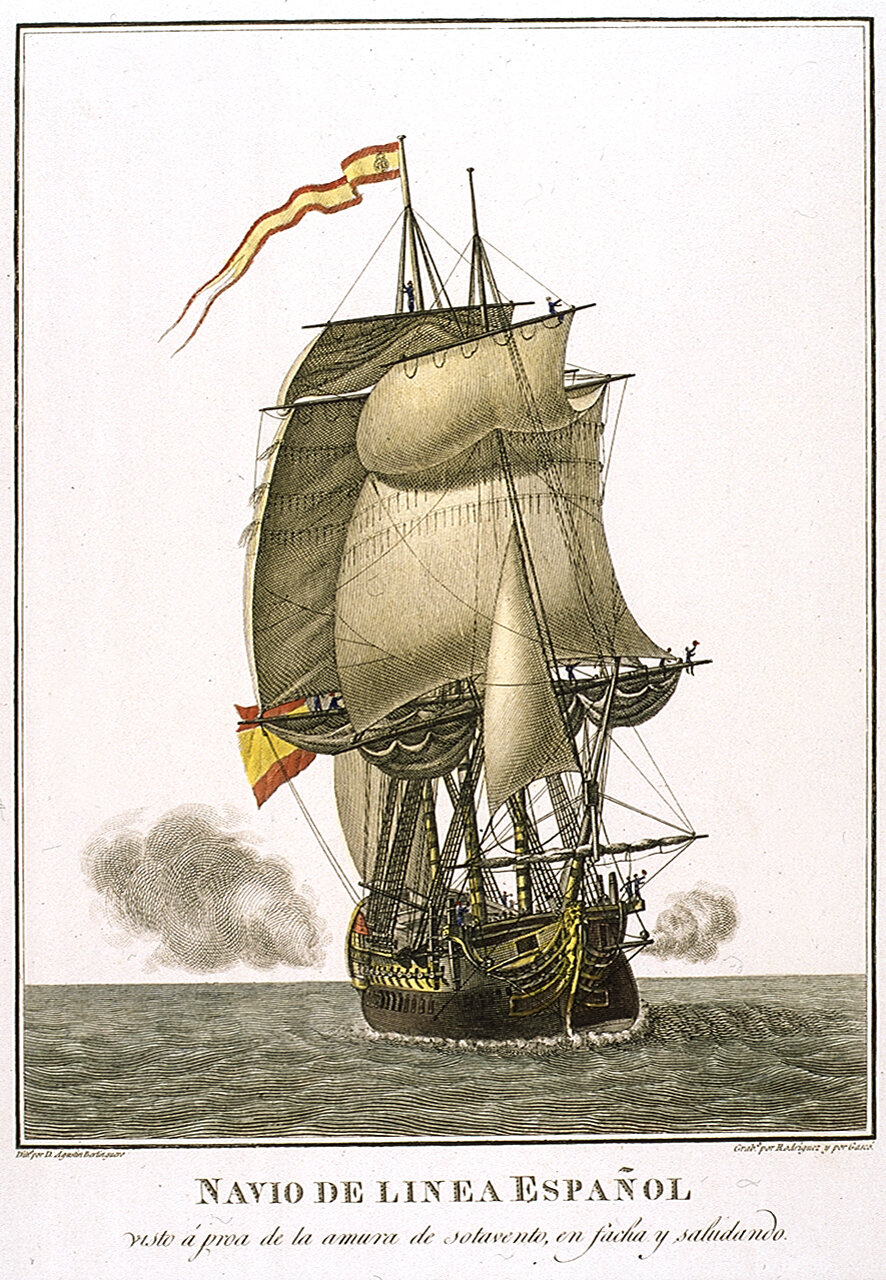
The ship of the line of 74 guns was, without question, the most important warship of the 18th century. Neither too large nor too small, it offered the perfect balance between firepower, speed, manoeuvrability and construction cost. In the Spanish Navy, the 74 became the backbone of the fleet, with over sixty units built throughout the century. This article explores the characteristics, evolution and role of these ships in Spanish naval history.
To understand their strategic importance, it suffices to compare the numbers: while Spain built only 22 three-decker ships (90-120 guns) in the entire 18th century, the 74 far exceeded that figure, with 63 units launched between 1720 and 1800. The Royal Navy, for its part, had more than 130 74-gun ships in service simultaneously in 1793, which gives an idea of the global dominance of this design. In France, the 74 was also the backbone of the French Royal Navy, with series such as the Téméraire class (107 units built between 1782 and 1813), considered the most successful design in the history of sailing navigation. The 74 was not just a ship: it was the foundation upon which the naval power of the Enlightenment rested, and its relative importance grew as the European powers realised that building large three-deckers was unsustainable for the needs of global coverage.
Technical characteristics of the Spanish 74
A Spanish 74-gun ship typically measured between 50 and 55 metres in length, 14 in beam and about 6.5 in draught, with a displacement close to 2,500 tons. Its crew ranged between 600 and 700 men. The artillery was distributed on two decks: on the lower gundeck went 24-pounder guns (28 units), on the upper gundeck 18-pounder guns (30 units), and on the quarterdeck and forecastle 8- or 12-pounder guns (16 units). This configuration, standardised from 1750 onwards, proved exceptionally effective in combat. As the RHN notes, the advantage of the 74 over larger ships such as the 112-gun ship lay in its better handling and in the fact that more could be built with the same resources.

To appreciate the differences between the principal navies, it is useful to compare the average dimensions of their 74s:
| Characteristic | Spanish 74 (San Ildefonso class) | British 74 (Arrogant class) | French 74 (Téméraire class) |
|---|---|---|---|
| Length (m) | 53.2 | 51.5 | 54.6 |
| Beam (m) | 14.5 | 14.2 | 14.3 |
| Draught (m) | 6.7 | 6.4 | 6.8 |
| Displacement (t) | 2,580 | 2,400 | 2,650 |
| Crew | 650 | 600 | 700 |
| Cost (reales de vellón) | ~1,200,000 | n/a | n/a |
As can be seen, the French 74s were slightly larger and heavier, while the British opted for smaller but faster and more economical ships to maintain. The Spanish, especially after the reforms of Jorge Juan, found a middle ground that combined structural solidity with good seakeeping qualities. The slightly deeper draught of the Spanish ships made them more stable as gun platforms, although it limited their access to shallow-water ports. This seemingly minor difference had operational consequences: British 74s could enter estuaries and rivers where Spanish ships dared not go, which partly explains British superiority in amphibious raids.
In terms of costs, the records of the Archivo General de Indias reveal that a 74 built in Havana cost about 800,000 reales de vellón, significantly less than the 1,200,000 that one built in Ferrol cost, due to the lower cost of American timbers. This economic difference largely explains the commitment to American construction in the second half of the century, especially when the royal treasury was going through its periodic fiscal crises.
Evolution from the Gaztañeta system to the English system
The first Spanish 74s, built according to the Gaztañeta system in the 1720s, were heavier and slower than their British counterparts. Jorge Juan’s mission to England (1749) radically changed this situation. After studying British shipyards, Juan introduced in Spain the English design of the 74, with finer hulls and better rigging. The Oriente (1753) was the prototype of this new generation. From then on, the arsenals of Ferrol, Cartagena, La Carraca and Havana produced entire series of 74s, such as those of the San Ildefonso class (1785) and San Fulgencio class (1787), which achieved fame for their excellent behaviour at sea. Todoavante documents that the San Ildefonso was captured by the British at Trafalgar and served for years in the Royal Navy, proof of the quality of Spanish construction.
The change of system was not merely technical, but also organisational. In 1752 Jorge Juan established regulations that unified the dimensions and proportions of all ships of the Navy, creating for the first time a national standard. Until then, each arsenal followed its own construction traditions, generating a heterogeneity that complicated maintenance and repairs. Jorge Juan’s new rules, based on the English model but adapted to Spanish timbers and conditions, allowed arsenals as distant as Ferrol and Havana to produce virtually identical ships. The RHN highlights that this was one of the most important administrative achievements of the Spanish Enlightenment Navy.

The San Ildefonso class, comprising eight ships built between 1785 and 1792, represented the culmination of Spanish 74 design. With a length of 53.2 metres and a displacement of 2,580 tons, these vessels incorporated significant improvements over previous generations: greater height between decks (which improved crew conditions in warm climates and reduced the incidence of disease), a reinforced bowsprit system, and a ballast distribution that optimised stability. The original San Ildefonso was launched in Cartagena in 1785 and fought at the Battle of Cape St Vincent (1797) before being captured at Trafalgar, where it was the only Spanish ship that struck its colours — not before having lost 34 men and having 148 wounded after hours of combat against three British ships simultaneously. The British, upon evaluating the ship after its capture, incorporated it into the Royal Navy as HMS San Ildefonso, where it served until 1814, a fate that few captured ships enjoyed unless they demonstrated exceptional quality.
The Spanish 74s in combat
The 74-gun ships took part in every major naval battle of the second half of the 18th century. At the Battle of Cape St Vincent (1797), several Spanish 74s fought with great valour against the British fleet. At Trafalgar (1805), the majority of Spanish ships were 74s, and some, such as the San Agustín, the San Francisco de Asís and the Montañés, fought heroically to the end. Especially notable was the San Juan Nepomuceno, under the command of Churruca, which single-handedly resisted the attack of three British ships before being shattered. The RHN devotes a monographic study to the performance of the 74s at Trafalgar, highlighting that, despite the defeat, the behaviour of these ships and their crews was worthy of the highest praise.

The casualty figures at Trafalgar offer a sobering perspective on the human cost of naval combat in the age of sail. Of the 15 Spanish ships present at the battle — 12 of them 74-gun ships — total losses amounted to 1,022 dead and 1,383 wounded, according to the figures compiled by Fernández Duro. The ship that suffered the most casualties was the Santa Ana (112 guns), but among the 74s the figures for the San Agustín (184 men out of action, dead and wounded) and the Montañés stand out: the latter, despite managing to escape the disaster with only 20 dead and 43 wounded, demonstrated the quality of its construction under the command of Captain Francisco Alsedo. The table of casualties of the Spanish 74s at Trafalgar is summarised as follows:
| Ship | Guns | Dead | Wounded | Total casualties | Fate |
|---|---|---|---|---|---|
| San Agustín | 74 | 47 | 137 | 184 | Captured |
| San Francisco de Asís | 74 | 15 | 52 | 67 | Beached |
| Montañés | 74 | 20 | 43 | 63 | Escaped |
| San Juan Nepomuceno | 74 | 35 | 89 | 124 | Captured |
| San Ildefonso | 74 | 34 | 148 | 182 | Captured |
| Bahama | 74 | 21 | 56 | 77 | Captured |
Beyond Trafalgar, the Spanish 74s also had notable performances in less well-known theatres. At the Battle of San Fernando Island (1798), the San Sebastián (74 guns) sustained an unequal fight for hours against a superior British squadron, managing to inflict considerable damage on HMS Thunderer before surrendering. In the Mediterranean, the Atlas took part in the defence of Toulon in 1793, covering the evacuation of French royalist troops with such accurate fire that the British commanders expressly requested its incorporation into the allied fleet after the operation. In the South Atlantic, the Arrogante and the Firme carried out convoy escort missions between Cádiz and Buenos Aires, protecting Spanish colonial trade from English privateers during the war of 1796-1802.
Special mention should be made of the performance of the San Ildefonso at the Battle of Cape Spartel (1782), where it formed part of the combined Franco-Spanish squadron that faced Admiral Howe. Although the battle was tactically inconclusive, the ability of the Spanish 74s to maintain formation under enemy fire impressed the French observers, who until then had considered Spanish naval construction inferior to their own. This change in perception was crucial for the Franco-Spanish alliance in the following years.

Construction in the American arsenals
One of the advantages of the standardisation of the 74 was that it could be built in the American arsenals. Havana and, to a lesser extent, Veracruz and Guayaquil, built numerous 74s with American timbers, especially cedar and mahogany, which proved more resistant to rot than European oak. The San Genaro (1765) and the San Ramón (1771) were two excellent examples of this American production. However, the dependence on American timbers also had its disadvantages: the tropical climate accelerated the degradation of the ships, and many 74s built in Havana needed major repairs within a few years of service.
The Havana arsenal was, by far, the most productive in the Americas. Between 1724 and 1798 it launched 23 ships of the line, of which 16 were 74-gun ships. The cedar wood used in these vessels had a density 15% lower than European oak, which reduced the total weight of the ship and allowed greater speed, but was also softer, making it more vulnerable to splinters in combat. The Archivo General de Indias preserves the reports of the commissioners who travelled to Havana to supervise construction, and they mention that American timber lasted, under normal conditions, about 10-12 years before needing careening, compared to 15-18 years for European oak — a significant difference that affected long-term maintenance costs and forced more frequent repair cycles to be scheduled.
Veracruz and Guayaquil had a more modest but technically notable production. From Veracruz came only three 74s, the last of them in 1784, while Guayaquil contributed two units, built with timbers from the Guayas basin — especially guachapelí and cedar — which proved exceptionally resistant to tropical shipworm. The ship San Pedro Alcántara, built in Guayaquil in 1776, was considered by Navy officers as one of the best-built of its era, and served for 22 years without needing major repairs, a record for a ship built in the American arsenals. This case demonstrates that, with adequate selection of materials and skilled labour, the American shipyards could equal — and even surpass — the quality of their peninsular counterparts.
Legacy
The 74-gun ship was the true workhorse of the Spanish Navy throughout the 18th century. Its balanced design, firepower and versatility made it the ideal vessel for a navy that had to protect a global empire with limited resources. When the 19th century brought steam-powered ships and ironclads, the old 74s were decommissioned or converted into hulks, but their legacy lived on in naval construction manuals around the world.
As late as 1860, when steam propulsion already dominated the seas, the Spanish Navy still kept several 74s in service, converted into training ships or artillery hulks. The Príncipe de Asturias, launched in 1793 as a 112-gun ship, was finally decommissioned in 1862. The 74s of the San Ildefonso class met a similar fate: the San Francisco de Paula was broken up in 1854, the San Antonio in 1858. With them closed a fundamental chapter of Spanish naval history, that of the sailing ship of the line, which for over a century had been the principal instrument of the empire’s defence policy. Today, the models at the Museo Naval de Madrid — such as that of the San Ildefonso — and the documents of the RHN and Todoavante keep alive the memory of those ships that, in the words of Fernández Duro, “were the pride of the Navy and the terror of the enemies of Spain”.

Sources and resources
- Revista de Historia Naval (RHN), no. 33, 1991: “El navío de 74 cañones en la Armada española”, by José María de la Guardia.
- Revista de Historia Naval (RHN), no. 75, 2001: “Los navíos de la clase San Ildefonso”, by Agustín Ramón Rodríguez González.
- Todoavante — “Navíos de 74 cañones españoles”
- Archivo General de Indias (PARES) — construction records of ships in Havana.
- Cesáreo Fernández Duro: Armada española desde la unión de los reinos de Castilla y Aragón, vol. VII.
- Museo Naval de Madrid — collection of ship models and naval models.
Related articles
- The ship San Ildefonso: a 74-gun ship of the Spanish Navy
- From Fragmentation to a Three-Deck Colossus: The Genesis, Splendor, and Decline of the 18th-Century Spanish Royal Navy
- The Mediterranean privateering and the Spanish privateers of the 18th century
Ver también: PARTE 3: La Habana 1762: cuando la logística falló | Viento en las velas: cómo la Royal Navy venció al escorbuto. Fuente: The 74gun ship the workhorse of the Spanish Navy.
Ver también en el glosario: Ship Of The Line, La Carraca, Escorbuto, Arsenal, Guardia, Convoy