the invincible armada and. the invincible armada and.
Relacionado: NAV-S27 · Lecciones de la Armada para hoy
Relacionado: NAV-S28 · Especial: lecciones de la Armada (cierre)
the invincible armada and.
the invincible armada and.
Preparations: the inheritance of Álvaro de Bazán and the forced replacement
The naval expedition that Philip II planned against England had a designated commander: Don Álvaro de Bazán, Marquis of Santa Cruz, veteran of Lepanto and architect of Spanish naval logistics. His death, which occurred on February 9, 1588, completely altered the board. The crown needed an immediate replacement and the one chosen was the Duke of Medina Sidonia, a nobleman competent in territorial administration but without experience in fleet command.
The appointment was not without controversy. Medina Sidonia had to catch up and reorganize forces that his predecessor had left in a different degree of preparation. He assumed command on February 16, 1588, the date that began the execution phase of the so-called «Enterprise of England.» Philip II had mobilized political, economic, religious and military resources, with the naval element in a preferential position within the plan.
The actual start-up of the machinery, however, was slow. Cesáreo Fernández Duro documents it harshly: between February and June 1588 the machinery was stopped. The provisions and money of the Flanders army were consumed, the troops were depleted by desertion and illness from camping on beaches, and the spirit of the organizing captain was fading. By the time the fleet set sail, the operational window had narrowed.
The fleet that crossed the Channel and the clash of Calais and Gravelines
The Great Armada left La Coruña on July 22, 1588. The figures vary depending on the source: some records speak of 130 ships, others of 134 ships and 49,589 tons. In front of it, the English fleet totaled 227 ships and 34,764 tons. The difference in tonnage and number favored the defenders, but the weight of the Spanish artillery was greater.
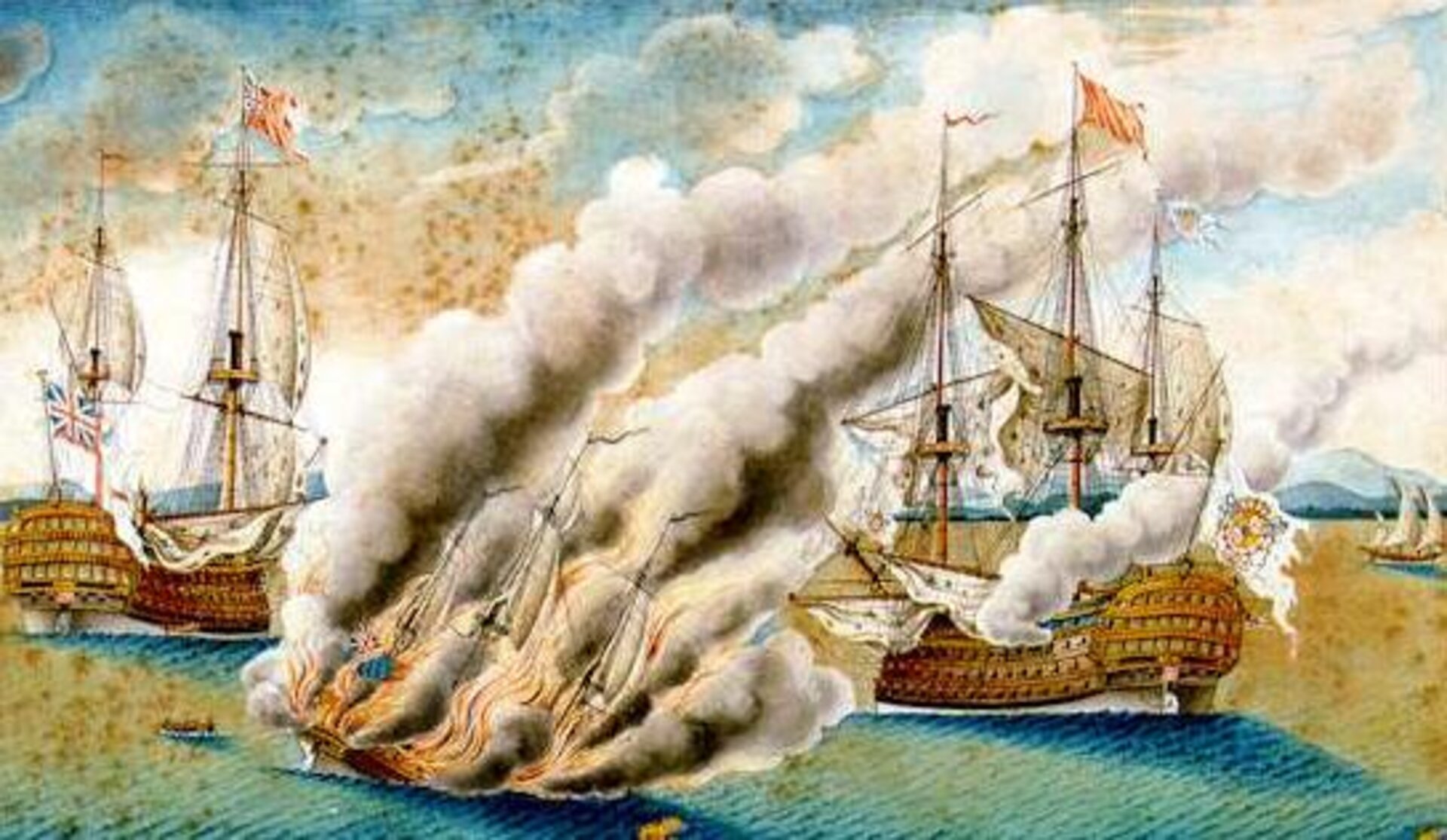
The southern coast of Britain was sighted on 29 July. From there the campaign was decided in two episodes. The first, the fire ship attack off Calais: many Spanish ships cut their anchor chains to escape, which dispersed the formation. In the subsequent assault, the general of the galleasses, Hugo de Moncada, died, hit by a shot from enemy boats. The galleasses—four units, San Lorenzo, Napolitana, Zúñiga and Girona—, built in 1583 and 1584 and weighing about 500 tons each, could not compensate for the disorder.
The second episode was the combat of Gravelines, on August 8. There the shipBegoñaShe received severe punishment from the English artillery and had to be rescued by the galleonSao Martin, flagship of Medina Sidonia. The day was not an annihilation, but it confirmed that the plan to link up with the Flanders army was unviable. The Armada had not been destroyed in the Channel; It had not met its objective either.
The galleasses of Naples: the bet that could not sustain the fight
The four galleasses constituted the most unique striking force of the expedition. Built in 1583 and 1584 in the Neapolitan arsenals, they weighed around 500 tons each and combined sail and rowing, with firepower designed to break enemy formations. Their performance in the Channel was hampered by the attack of the fire ships: dispersed, without chains to anchor them to the formation, they were at the mercy of the English boats. The general of the galleasses, Hugo de Moncada, was killed by a shot from one of them. TheGirona, the most famous of the four, met its end weeks later on the Irish coast, and its treasures and cannons have been recovered by archaeologists in the 20th century. The balance of the unit was the failure of a doctrine: the galleass, a calm water weapon, could not sustain the attritional combat of the Canal.
The composition of the fleet: nine groups and half a dozen functions
The Great Armada was not a homogeneous block, but an armada of navies. The records of Notebook 27 of the Institute of Naval History and Culture, which systematizes José Luis Casado’s tables, break down the force into nine groups with different functions: combat squads, a squadron of urcas for transport, another of pataches and zabras for links, and the galleasses as a shock force. The totals that these tables handle — 4,451 tons for the Portuguese Squadron, 5,333 for the Vizcaya Squadron, 8,973 for the 21 urcas — allow the company to be sized with precision.
A fleet where half did not fight
The most revealing data in the breakdown is that of non-combatants. Of the total of 134 vessels, 67—exactly half—belonged to the transport or service category: two galleonces of the Portuguese Squadron, pataches and pinnaces from Castilla, Vizcaya and Guipúzcoa, the 21 urcas (8,973 tons), eleven pataches and seven zabras of the pataches squadron, and the eleven aguada caravels that ensured the supply of fresh water. They totaled 13,170 tons that did not fire a cannon in the line of battle. This dead weight conditioned the maneuver: a formation of 134 sails was, in reality, an escort of 67 combat ships surrounded by a vulnerable logistics train, the ideal target for the harassment tactic that Howard and Drake applied in the Channel.
Tonnage as a common language of logistics
The tables in notebook 27 use tonnage (metric tons of pay) as a homogeneous measure to compare ships of very diverse origin: Portuguese galleons, Basque ships, German and Flemish urcas, and aguada caravels. This unification of criteria is the heritage of the school of builders of the 16th century, and explains why the figures for the expedition range between 130 ships in some records and 134 in others: depending on the transports and smaller vessels, the number varies without changing the total tonnage, fixed at around 49,589 tons. The English Navy, by contrast, had 227 ships but only 34,764 tons: more sails, less mass.
The return: shipwrecks, illness and the wear and tear of a long war
The return to Spain became a long series of losses. On September 22, 1588, the surviving ships began to enter Spanish ports with battered crews and a considerable number of sick people on board. Scurvy and typhus had taken their toll during the voyage, according to contemporary sources. The balance was 102 badly damaged ships and 25 shipwrecks on the coasts of Scotland and Ireland.
A year later, England counterattacked with the Contra Armada, under the command of Drake. The expedition, of 180 ships according to one count or 190 according to another, and almost 27,700 men, had three purposes: to destroy the remains of the Great Armada under repair in Santander, to conquer Lisbon to place the prior of Crato on the Portuguese throne, and to intercept the Indies Fleet in the Azores. Already in the autumn of 1588 rumors about these preparations were circulating in London.
The English result was adverse. Drake lost half of his troops and nine ships, seven of them off Lisbon. In La Coruña, the landing attempts failed due to the resistance of 1,500 improvised soldiers and the population; On 18 May, Drake was forced to reembark and left port the next day. The two navies, the Spanish of 1588 and the English of 1589, returned home with 102 ships each.
The strategic rereading of the episode matters as much as its numbers. The defeat of the Armada in the Channel has often been presented as a decisive British success. In reality it was a tactical victory within the framework of a war that lasted sixteen years and which, according to the documentation consulted, Spain ended up winning. The English Contra Armada suffered a greater defeat in La Coruña and Lisbon, in relative terms, than that suffered by Invincible itself.
Logistical consequences and lessons for naval organization
The campaign of 1588 left operational lessons that the European navies would take time to assimilate. The first is the primacy of logistics over the number of ships. The Great Armada left with a manifestly insufficient complement of rowers: the Naples galleys left with only 943 rowers, which gave an average of 4.9 per bank. The second is the vulnerability of an anchored fleet against fire ships, corrected in subsequent campaigns with surveillance devices and firewalls. The third, less obvious but decisive, is that the ability to repair and rearm in its own port defines the continuity of a naval war: the remains of the Great Navy were rebuilt in Santander while England was unable to capitalize on its victory in the Channel.
The war against England did not end in Gravelines or in the return of 1588. It continued in the Cantabrian ports, in Lisbon and in the Azores, and only concluded with a treaty that recognized the balance achieved. The Invincible Armada failed in its invasion objective, but England’s enterprise was not, in terms of strategic attrition, a unilateral disaster. Both powers suffered comparable losses in ships and men, and both understood that mastery of the sea is not decided in a single day.
Sources consulted
- Naval History Magazine, no. 143
- Naval History Magazine, no. 152
- Naval History Magazine, no. 153
- Naval History Magazine, no. 139
- Naval History Magazine, no. 120
- Naval History Magazine, no. 134
- Naval History Magazine, no. 126
- Naval History Magazine, no. 110
- Library of Congress
- Library of Congress
- Library of Congress
- Library of Congress
- Cesáreo Fernández Duro,Spanish Navy, volume III
Related articles
- PARTE 3: La Habana 1762: cuando la logística falló
- PARTE 2: Astilleros, pertrechos y víveres: la máquina logística de la Armada
- PARTE 1: El sistema de flotas y galeones: la logística que sostenía un imperio
Ver también: PARTE 3: La Habana 1762: cuando la logística falló | Viento en las velas: cómo la Royal Navy venció al escorbuto. Fuente: The Invincible Armada and the Great Armada of 1588 preparations defeat and consequences.
Ver también en el glosario: Astilleros, Escorbuto, Víveres
Deja una respuesta