Author: admin

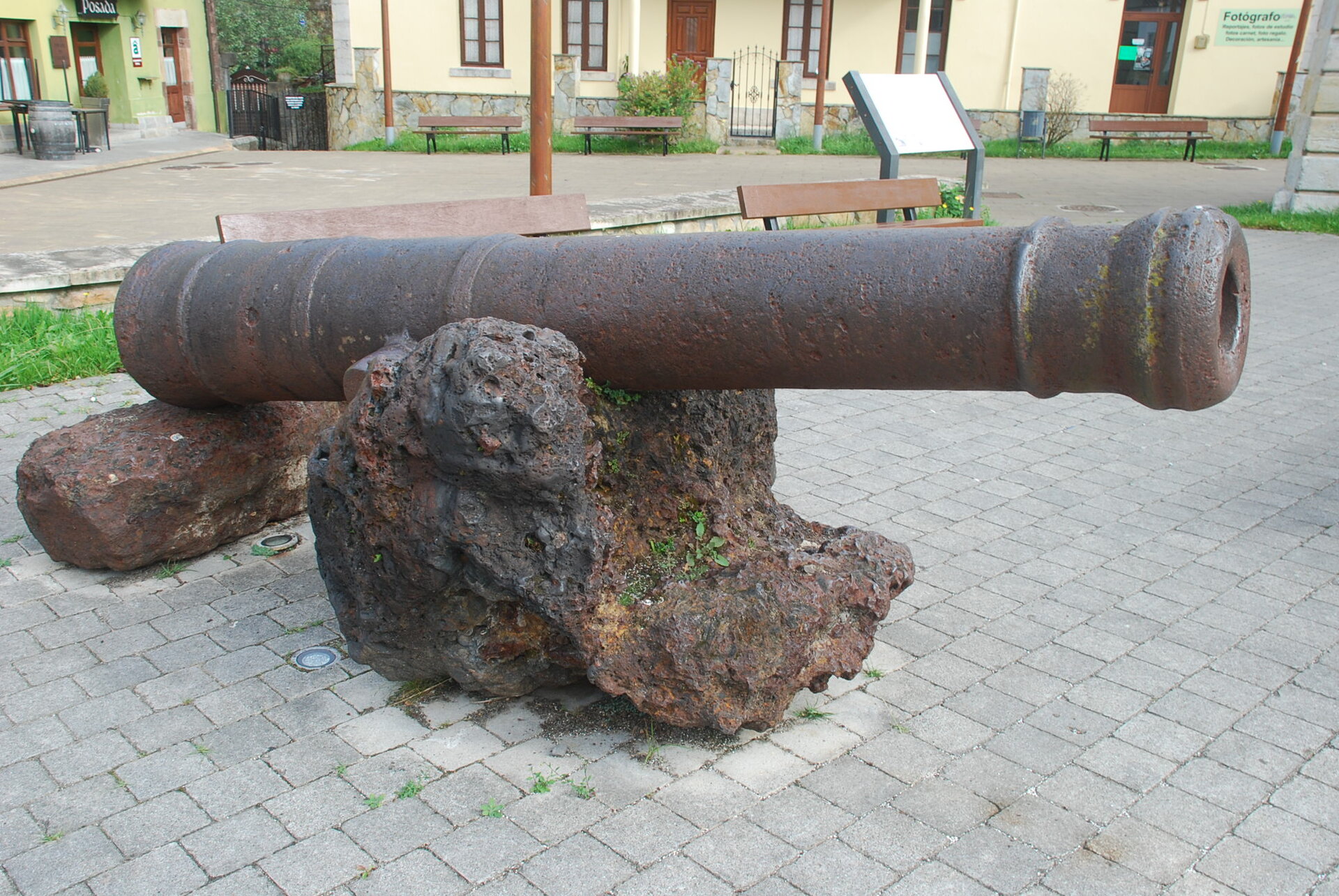
  • Naval artillery: cannons, carronades and howitzers

    Introduction

    Naval artillery was the decisive element in 18th-century combat. The evolution of naval guns — from heavy bronze cannons to modern iron carronades — completely transformed combat tactics at sea. Spain, with a foundry tradition dating back to the 16th century, maintained a high level of artillery production, although it could not always compete in quantity with the burgeoning British industry. This article examines the types of pieces, their manufacture and their tactical employment in the Spanish Navy of the 18th century.

    Bronze and iron cannons

    At the beginning of the 18th century, Spanish naval cannons were mostly cast in bronze, an alloy of copper and tin that offered great resistance to corrosion but was very expensive. Each 24-pounder bronze cannon cost the equivalent of several months’ salary of a ship’s captain. For this reason, over the course of the century, the Navy gradually replaced bronze with cast iron, which was cheaper and more durable. The foundries of La Cavada (Santander) and Liérganes produced iron cannons of excellent quality for decades, although production was never sufficient to supply the entire fleet. As the RHN notes, dependence on imports of Swedish iron and English cannons (via smuggling) was a constant problem for Spanish artillery.

    Calibres and types of pieces

    18th-century naval artillery was classified by the weight of the projectile, that is, by calibre. The most common calibres were:

    • 36-pounder cannons: the heaviest pieces, mounted on the lower gundeck of first-rate ships.
    • 24-pounder cannons: the standard calibre of the lower gundeck on 74-gun ships.
    • 18-pounder cannons: mounted on the upper gundeck.
    • 12- and 8-pounder cannons: used on the quarterdeck and forecastle.
    • Howitzers: short, large-calibre pieces designed to fire explosive shells on a curved trajectory. They were especially useful in coastal bombardments.
    • Carronades: introduced by the British Navy in the 1770s, they were short, light, large-calibre guns that fired at short range. The Spanish Navy adopted them at the end of the century, mounting them on the quarterdeck of many ships.

    Todoavante documents that Spanish artillery experimented with 48-pounder pieces, but they proved too heavy and too slow to reload, so they never became widespread.

    Manufacture: foundries and suppliers

    The most important foundry in Spain was the Real Fábrica de Artillería de La Cavada, in Cantabria, active since 1635. There the iron cannons that armed the Navy’s ships throughout the 18th century were cast. Foundries also operated in Seville, Barcelona and Málaga, although with lower production. In the Americas, the foundries of Mexico and Peru supplied bronze cannons for ships built in the arsenals of Havana and Veracruz. The quality of Spanish iron was recognised throughout Europe, but production was limited by the availability of iron ore and charcoal. The RHN highlights that, in times of war, the shortage of cannons was a critical problem: many Spanish ships put to sea with fewer pieces than regulation required, or with pieces of different calibres that complicated ammunition supply.

    Spanish artillery tactics

    Spanish artillery tactics in the 18th century differed from British ones. While the British sought close-range combat, discharging devastating broadsides against the enemy hull, the Spanish preferred to fire at medium range, aiming at the masts and rigging to immobilise the opponent and then board. This tactic, inherited from the previous century, proved obsolete in the face of British artillery superiority. Nevertheless, at the end of the century, the most modern Spanish officers — such as Gravina and Churruca — adopted English tactics, training their crews in rapid rate of fire and accurate aiming. At Trafalgar, some Spanish ships achieved rates of fire comparable to the British, although the lack of joint practice and the heterogeneity of the combined fleet made it insufficient.

    📚 Sources and resources

  • The 74-gun ship: the workhorse of the Spanish Navy

    Introduction

    The ship of the line of 74 guns was, without question, the most important warship of the 18th century. Neither too large nor too small, it offered the perfect balance between firepower, speed, manoeuvrability and construction cost. In the Spanish Navy, the 74 became the backbone of the fleet, with over sixty units built throughout the century. This article explores the characteristics, evolution and role of these ships in Spanish naval history.

    To understand their strategic importance, it suffices to compare the numbers: while Spain built only 22 three-decker ships (90-120 guns) in the entire 18th century, the 74 far exceeded that figure, with 63 units launched between 1720 and 1800. The Royal Navy, for its part, had more than 130 74-gun ships in service simultaneously in 1793, which gives an idea of the global dominance of this design. In France, the 74 was also the backbone of the French Royal Navy, with series such as the Téméraire class (107 units built between 1782 and 1813), considered the most successful design in the history of sailing navigation. The 74 was not just a ship: it was the foundation upon which the naval power of the Enlightenment rested, and its relative importance grew as the European powers realised that building large three-deckers was unsustainable for the needs of global coverage.

    Technical characteristics of the Spanish 74

    A Spanish 74-gun ship typically measured between 50 and 55 metres in length, 14 in beam and about 6.5 in draught, with a displacement close to 2,500 tons. Its crew ranged between 600 and 700 men. The artillery was distributed on two decks: on the lower gundeck went 24-pounder guns (28 units), on the upper gundeck 18-pounder guns (30 units), and on the quarterdeck and forecastle 8- or 12-pounder guns (16 units). This configuration, standardised from 1750 onwards, proved exceptionally effective in combat. As the RHN notes, the advantage of the 74 over larger ships such as the 112-gun ship lay in its better handling and in the fact that more could be built with the same resources.

    Plans of a Spanish 74-gun ship designed by José Romero Fernández de Landa. Public domain.
    Plans of a Spanish 74-gun ship designed by José Romero Fernández de Landa. Public domain.

    To appreciate the differences between the principal navies, it is useful to compare the average dimensions of their 74s:

    Characteristic Spanish 74 (San Ildefonso class) British 74 (Arrogant class) French 74 (Téméraire class)
    Length (m) 53.2 51.5 54.6
    Beam (m) 14.5 14.2 14.3
    Draught (m) 6.7 6.4 6.8
    Displacement (t) 2,580 2,400 2,650
    Crew 650 600 700
    Cost (reales de vellón) ~1,200,000 n/a n/a

    As can be seen, the French 74s were slightly larger and heavier, while the British opted for smaller but faster and more economical ships to maintain. The Spanish, especially after the reforms of Jorge Juan, found a middle ground that combined structural solidity with good seakeeping qualities. The slightly deeper draught of the Spanish ships made them more stable as gun platforms, although it limited their access to shallow-water ports. This seemingly minor difference had operational consequences: British 74s could enter estuaries and rivers where Spanish ships dared not go, which partly explains British superiority in amphibious raids.

    In terms of costs, the records of the Archivo General de Indias reveal that a 74 built in Havana cost about 800,000 reales de vellón, significantly less than the 1,200,000 that one built in Ferrol cost, due to the lower cost of American timbers. This economic difference largely explains the commitment to American construction in the second half of the century, especially when the royal treasury was going through its periodic fiscal crises.

    Evolution from the Gaztañeta system to the English system

    The first Spanish 74s, built according to the Gaztañeta system in the 1720s, were heavier and slower than their British counterparts. Jorge Juan’s mission to England (1749) radically changed this situation. After studying British shipyards, Juan introduced in Spain the English design of the 74, with finer hulls and better rigging. The Oriente (1753) was the prototype of this new generation. From then on, the arsenals of Ferrol, Cartagena, La Carraca and Havana produced entire series of 74s, such as those of the San Ildefonso class (1785) and San Fulgencio class (1787), which achieved fame for their excellent behaviour at sea. Todoavante documents that the San Ildefonso was captured by the British at Trafalgar and served for years in the Royal Navy, proof of the quality of Spanish construction.

    The change of system was not merely technical, but also organisational. In 1752 Jorge Juan established regulations that unified the dimensions and proportions of all ships of the Navy, creating for the first time a national standard. Until then, each arsenal followed its own construction traditions, generating a heterogeneity that complicated maintenance and repairs. Jorge Juan’s new rules, based on the English model but adapted to Spanish timbers and conditions, allowed arsenals as distant as Ferrol and Havana to produce virtually identical ships. The RHN highlights that this was one of the most important administrative achievements of the Spanish Enlightenment Navy.

    Cross-section of the main frame of the ship San Juan Nepomuceno (1766-1805), an 18th-century model for comparing English and French construction systems. Museo Naval de Madrid. CC BY-SA 4.0.
    Cross-section of the main frame of the ship San Juan Nepomuceno (1766-1805), an 18th-century model for comparing English and French construction systems. Museo Naval de Madrid. CC BY-SA 4.0.

    The San Ildefonso class, comprising eight ships built between 1785 and 1792, represented the culmination of Spanish 74 design. With a length of 53.2 metres and a displacement of 2,580 tons, these vessels incorporated significant improvements over previous generations: greater height between decks (which improved crew conditions in warm climates and reduced the incidence of disease), a reinforced bowsprit system, and a ballast distribution that optimised stability. The original San Ildefonso was launched in Cartagena in 1785 and fought at the Battle of Cape St Vincent (1797) before being captured at Trafalgar, where it was the only Spanish ship that struck its colours — not before having lost 34 men and having 148 wounded after hours of combat against three British ships simultaneously. The British, upon evaluating the ship after its capture, incorporated it into the Royal Navy as HMS San Ildefonso, where it served until 1814, a fate that few captured ships enjoyed unless they demonstrated exceptional quality.

    The Spanish 74s in combat

    The 74-gun ships took part in every major naval battle of the second half of the 18th century. At the Battle of Cape St Vincent (1797), several Spanish 74s fought with great valour against the British fleet. At Trafalgar (1805), the majority of Spanish ships were 74s, and some, such as the San Agustín, the San Francisco de Asís and the Montañés, fought heroically to the end. Especially notable was the San Juan Nepomuceno, under the command of Churruca, which single-handedly resisted the attack of three British ships before being shattered. The RHN devotes a monographic study to the performance of the 74s at Trafalgar, highlighting that, despite the defeat, the behaviour of these ships and their crews was worthy of the highest praise.

    The Spanish ship Bahama (74 guns), painted by Rafael Berenguer (1822-1890). Museo Naval de Madrid. Public domain.
    The Spanish ship Bahama (74 guns), painted by Rafael Berenguer (1822-1890). Museo Naval de Madrid. Public domain.

    The casualty figures at Trafalgar offer a sobering perspective on the human cost of naval combat in the age of sail. Of the 15 Spanish ships present at the battle — 12 of them 74-gun ships — total losses amounted to 1,022 dead and 1,383 wounded, according to the figures compiled by Fernández Duro. The ship that suffered the most casualties was the Santa Ana (112 guns), but among the 74s the figures for the San Agustín (184 men out of action, dead and wounded) and the Montañés stand out: the latter, despite managing to escape the disaster with only 20 dead and 43 wounded, demonstrated the quality of its construction under the command of Captain Francisco Alsedo. The table of casualties of the Spanish 74s at Trafalgar is summarised as follows:

    Ship Guns Dead Wounded Total casualties Fate
    San Agustín 74 47 137 184 Captured
    San Francisco de Asís 74 15 52 67 Beached
    Montañés 74 20 43 63 Escaped
    San Juan Nepomuceno 74 35 89 124 Captured
    San Ildefonso 74 34 148 182 Captured
    Bahama 74 21 56 77 Captured

    Beyond Trafalgar, the Spanish 74s also had notable performances in less well-known theatres. At the Battle of San Fernando Island (1798), the San Sebastián (74 guns) sustained an unequal fight for hours against a superior British squadron, managing to inflict considerable damage on HMS Thunderer before surrendering. In the Mediterranean, the Atlas took part in the defence of Toulon in 1793, covering the evacuation of French royalist troops with such accurate fire that the British commanders expressly requested its incorporation into the allied fleet after the operation. In the South Atlantic, the Arrogante and the Firme carried out convoy escort missions between Cádiz and Buenos Aires, protecting Spanish colonial trade from English privateers during the war of 1796-1802.

    Special mention should be made of the performance of the San Ildefonso at the Battle of Cape Spartel (1782), where it formed part of the combined Franco-Spanish squadron that faced Admiral Howe. Although the battle was tactically inconclusive, the ability of the Spanish 74s to maintain formation under enemy fire impressed the French observers, who until then had considered Spanish naval construction inferior to their own. This change in perception was crucial for the Franco-Spanish alliance in the following years.

    Replica of the Spanish Navy ship San Juan Nepomuceno, sunk in 1805. CC BY-SA 2.0.
    Replica of the Spanish Navy ship San Juan Nepomuceno, sunk in 1805. CC BY-SA 2.0.

    Construction in the American arsenals

    One of the advantages of the standardisation of the 74 was that it could be built in the American arsenals. Havana and, to a lesser extent, Veracruz and Guayaquil, built numerous 74s with American timbers, especially cedar and mahogany, which proved more resistant to rot than European oak. The San Genaro (1765) and the San Ramón (1771) were two excellent examples of this American production. However, the dependence on American timbers also had its disadvantages: the tropical climate accelerated the degradation of the ships, and many 74s built in Havana needed major repairs within a few years of service.

    The Havana arsenal was, by far, the most productive in the Americas. Between 1724 and 1798 it launched 23 ships of the line, of which 16 were 74-gun ships. The cedar wood used in these vessels had a density 15% lower than European oak, which reduced the total weight of the ship and allowed greater speed, but was also softer, making it more vulnerable to splinters in combat. The Archivo General de Indias preserves the reports of the commissioners who travelled to Havana to supervise construction, and they mention that American timber lasted, under normal conditions, about 10-12 years before needing careening, compared to 15-18 years for European oak — a significant difference that affected long-term maintenance costs and forced more frequent repair cycles to be scheduled.

    Veracruz and Guayaquil had a more modest but technically notable production. From Veracruz came only three 74s, the last of them in 1784, while Guayaquil contributed two units, built with timbers from the Guayas basin — especially guachapelí and cedar — which proved exceptionally resistant to tropical shipworm. The ship San Pedro Alcántara, built in Guayaquil in 1776, was considered by Navy officers as one of the best-built of its era, and served for 22 years without needing major repairs, a record for a ship built in the American arsenals. This case demonstrates that, with adequate selection of materials and skilled labour, the American shipyards could equal — and even surpass — the quality of their peninsular counterparts.

    Legacy

    The 74-gun ship was the true workhorse of the Spanish Navy throughout the 18th century. Its balanced design, firepower and versatility made it the ideal vessel for a navy that had to protect a global empire with limited resources. When the 19th century brought steam-powered ships and ironclads, the old 74s were decommissioned or converted into hulks, but their legacy lived on in naval construction manuals around the world.

    As late as 1860, when steam propulsion already dominated the seas, the Spanish Navy still kept several 74s in service, converted into training ships or artillery hulks. The Príncipe de Asturias, launched in 1793 as a 112-gun ship, was finally decommissioned in 1862. The 74s of the San Ildefonso class met a similar fate: the San Francisco de Paula was broken up in 1854, the San Antonio in 1858. With them closed a fundamental chapter of Spanish naval history, that of the sailing ship of the line, which for over a century had been the principal instrument of the empire’s defence policy. Today, the models at the Museo Naval de Madrid — such as that of the San Ildefonso — and the documents of the RHN and Todoavante keep alive the memory of those ships that, in the words of Fernández Duro, “were the pride of the Navy and the terror of the enemies of Spain”.

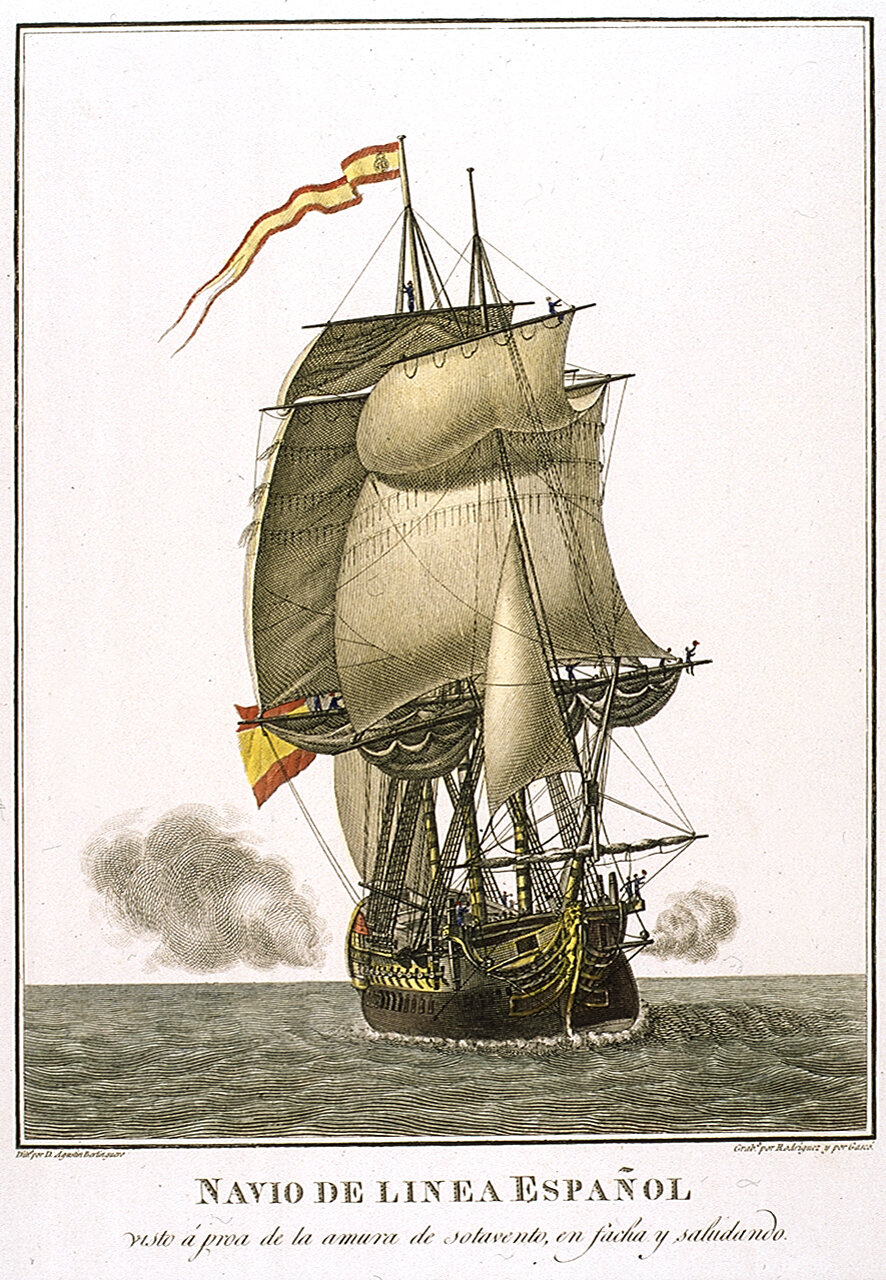
    Spanish 74-gun ship. Bow view, sailing downwind and pitching in a squall. Coloured engraving by Berlinguero, Gasco and Rodríguez. Public domain.
    Spanish 74-gun ship. Bow view, sailing downwind and pitching in a squall. Coloured engraving by Berlinguero, Gasco and Rodríguez. Public domain.

    📚 Sources and resources


  • A Navy Is Born: Alfonso X and the Creation of the Castilian Navy

    A Navy Is Born: Alfonso X and the Creation of the Castilian Navy

    The Sea, the Unfinished Business of the Reconquista

    When Ferdinand III conquered Seville in 1248, the kingdom of Castile looked out upon the Mediterranean with a substantial coastline for the first time. But that victory, achieved with ships brought from the Cantabrian coast under the command of Ramón Bonifaz, revealed a strategic deficiency that his son and successor, Alfonso X the Wise, was the first to diagnose clearly: without a permanent navy, any territorial advance was vulnerable. The Muslim supply routes through the Strait of Gibraltar remained open, and the newly conquered coasts lacked their own naval protection.

    The chronicler and auditor general José Cervera Pery, in his seminal study Las empresas navales del reino de Castilla —included in the Castilla y el mar series— notes that Castile became a maritime kingdom when Alfonso X consolidated his father’s territorial conquest, incorporating the towns of the western Andalusian coast (Cádiz, El Puerto de Santa María, and Cartagena) and repopulating them with seafaring people from the Cantabrian region. The sea ceased to be a frontier and became both an opportunity and an open front.

    The Seville Shipyards: The First Royal Arsenal

    Alfonso X’s first step was a tangible one. In 1252, barely a year after ascending the throne, he ordered the reconstruction of the Almohad shipyards of Seville, a vast complex of 19 vaulted bays covering a perimeter of 1,600 feet and reaching 45 feet in height (approximately 426.5 by 12 meters). They were by far the largest naval facilities on the Peninsula. To put them into operation, the king reserved certain forests for timber and attracted skilled workers through tax benefits, creating a payroll of privileged workers who ensured the fleet’s maintenance.

    The historian Eduardo Aznar Vallejo, in his work La guerra naval en Castilla durante la Baja Edad Media, also documents the shipyards of Santander, though these were much more modest: four bays totaling about 68 by 37 meters. The researcher notes that these facilities were reserved for light vessels — galleys and similar types — which constituted a small portion of the northern fleet, composed mostly of round-hulled ships such as naves and naos from the Cantabrian coast.

    The Corps of Cómitres: Seamen in the King’s Service

    One year after setting the shipyards into motion, Alfonso X laid the foundations of a stable naval organization. In 1253, he concluded an agreement with the master of the Order of Santiago, Pelayo Pérez Correa, by which the military order committed to maintaining a galley with 200 men for three months each year, in exchange for 1,600 aranzadas of olive groves in the Aljarafe region. Any booty obtained would be split equally between the king and the master.

    That same year — or perhaps already in 1254 — the monarch signed a contract with ten cómitres (galley masters). Each one undertook to maintain at his own expense a galley, to be rebuilt or replaced every nine years, and to keep it ready for navigation and combat. In exchange, the king granted them a landed estate whose revenues could cover the obligation. They were required to keep five armed men on board the galley and to replace it within seven years if it were lost. Booty was again split fifty-fifty. The first cómitres were mostly French, Catalan, and Genoese, along with some Cantabrians: the Crown imported technical knowledge from the Mediterranean to place it at the service of the new Castilian navy.

    As Miguel Ángel Ladero Quesada, member of the Royal Academy of History and author of the study El almirantazgo de Castilla en la Baja Edad Media (included in the Castilla y el mar series), explains, King Alfonso X pursued an active naval policy in the early years of his reign, and the agreement with the cómitres was a key piece of that framework. Each galley was to carry 100 men clad in iron, 50 lances, 4 stirrup crossbows and 2 two-foot crossbows, as well as 1,000 quarrels (arrows of toasted wood), 10 shields, and 10 iron helmets.

    The Admiralty of Castile: An Institution for the Ages

    In December 1254, Ruy López de Mendoza, one of the three arbiters of the Repartimiento of Seville and its territory, began to be styled Admiral. It was not an empty title: the admiral not only commanded the fleet in battle but also served as judge in maritime affairs, oversaw ship construction, and administered the royal ports. That office would become one of the longest-lived institutions in Spanish history, enduring for centuries.

    The Siete Partidas, the great legal code promoted by Alfonso X, devoted meticulous attention to naval warfare. It distinguished between a flota (a body of galleys and ships serving the king with a large company of men, akin to a land army) and an armada (a smaller number of vessels prepared for a specific occasion). It enumerated the types of vessels — from naves and carracks to galleys, galiots, taridas, saetías, and leños — the weapons (darts, stirrup and windlass crossbows, swords, axes, hooked lances), and the equipment. Even the shipboard provisions were recorded: hardtack, salted meat, legumes, cheese, and garlic to prevent spoilage, along with water, cider, and wine.

    The law also established how to divide the spoils of war. If the king provided all elements — ships, wages, armament, and food — he received the full profit. Otherwise, he shared it in quarters with the contributors. From the profits of private individuals, the king took a fifth, and his admiral a seventh.

    The Order of Santa María de España and the African Project

    Alfonso X did not stop there. Seeing the need for a permanent naval force with religious inspiration, he created the Order of Santa María de España “for the business of the sea,” headquartered in El Puerto de Santa María — a town the king himself had founded — with convents in Cartagena, San Sebastián, and La Coruña. The order was conceived to fight Muslims at sea and protect the Castilian coasts. However, its existence was short-lived: it disappeared in 1280, absorbed by the Order of Santiago, which took over its lordships and revenues.

    The Wise King also planned the so-called “Crusade of Africa,” for which he sought help from the Aragonese and English monarchs. Of that enterprise, only the brief occupation of Salé, on the Atlantic coast of present-day Morocco, in 1260 remains. An expedition led by Juan García de Villamayor, the king’s steward, acting as adelantado mayor de la mar — a temporary office, not to be confused with that of admiral, as Ladero Quesada clarifies — which had no continuity. Castile still lacked the logistical resources to sustain long-range overseas campaigns.

    The Algeciras Campaign: The Fleet in Action

    The fighting potential of the navy created by Alfonso X was put to the test in the campaign against Algeciras in 1278–1279. According to the Chronicle of Alfonso X, the Castilian fleet numbered as many as 80 galleys and 24 naves, not counting galiots, leños, and other smaller vessels. For its time, it was an imposing force.

    However, on July 25, 1279, Admiral Pedro Martínez de Fe suffered a resounding defeat at the hands of the Muslim fleet off Algeciras. The disaster was total: the fleet scattered, the admiral had to take his ship to Tangier and remained a prisoner for two years. That catastrophe, combined with the political crisis of the final years of his reign, led Alfonso X to abandon his naval projects. Yet the seed had already been planted. As the study from the Castilla y el mar series notes, the sum of Alfonso’s initiatives — shipyards, cómitres, admiralty, legislation — constituted “a notable war-fighting power” that his successors would inherit and expand.

    The Legacy: From Alfonso X to the Battle of the Strait

    The torch was taken up by his son Sancho IV, who, facing the Marinid threat, hired the services of the Genoese Benedetto Zaccaria — one of the most experienced seamen of the Mediterranean, a veteran of Constantinople and the Battle of Meloria — with 12 armed and equipped galleys. Zaccaria won a great victory over the Marinids on August 6, 1291, and intervened decisively in the conquest of Tarifa (October 1292). But the most brilliant chapter of that early Castilian navy would be written in the following century, under Alfonso XI, during the so-called “Battle of the Strait.”

    Ladero Quesada, in his meticulous study of the admiralty, highlights the figure of Jofre Tenorio, admiral to Alfonso XI between 1314 and 1340. His naval intervention during the royal campaign of 1326 against Granada — guarding the coast with 6 galleys, 8 naos, and 6 leños — illustrates the operational capability that the Castilian navy had achieved. Tenorio also defeated the Portuguese fleet of the Genoese Manuel Pessaño in September 1337 near Lisbon.

    Just three years later, however, Tenorio would die in an unequal fight against the Marinid fleet in the Bay of Algeciras. His head, according to the Chronicle of Alfonso XI, was cut off by the Muslims. War at sea, as the legal literature of the time collected in the Castilla y el mar series already acknowledged, “is like a forsaken thing, and of greater peril than war on land.”

    From the Cantabrian Coast to the Strait: The Fruits of Alfonso’s Policy

    The creation of the admiralty by Alfonso X was not a symbolic gesture. In the reign of Peter I — called the Just by some, the Cruel by others — naval endeavor reached extraordinary heights. The historian José Cervera Pery, in the work included in Castilla y el mar, offers a revealing fact: after suffering a setback at Guardamar in 1358, in which he lost nearly his entire fleet to a storm, Peter I did not abandon his naval efforts, and within eight months twelve new galleys were built and fifteen of the old ones were refitted. That capacity for recovery, impossible without the institutional and material base created by Alfonso X, allowed Castile to do battle with the powerful Aragonese squadron on its own coasts.

    The chronicler Jerónimo de Zurita summarized the novelty of the situation with these words: “in times past, the kings of Castile were never so sovereign at sea that they could undertake war on their own except against the Moors, and that with the help of the kings of Aragon and the Genoese, because of the great difficulty they had in arming galleys.” By the time those lines were written, the situation had changed completely.

    A curious later episode shows just how much. After relations between the two kingdoms were restored, as Aznar Vallejo documents, Castile asked Aragon to send men instead of galleys, arguing that “the Moors had no fleet superior to that of the king of Castile.” The request, read in its context, is a clear indicator of the confidence — and the reality — of the naval power that Alfonso X had set in motion a century earlier.

    The crowning touch of that long voyage would come under John II, in the final stages of the Hundred Years’ War, when — according to Cervera Pery — “a powerful fleet facilitated, thanks to a brilliant naval campaign, the incorporation into French territory of the strongholds of Bordeaux and Bayonne.” Without the navy that Alfonso X imagined and built, none of those achievements would have been possible.

    Conclusion

    Alfonso X the Wise was not only a lawgiver and a poet; he was also the architect of the first Castilian war navy. His shipyards of Seville, his corps of cómitres, the creation of the Admiralty, and the regulation of naval warfare in the Siete Partidas constitute the foundations upon which Castile’s maritime power was built. Although his most ambitious projects — the conquest of Africa, the Order of Santa María de España — remained unfinished, the machinery he set in motion proved its effectiveness for generations. From the Cantabrian coast to the Strait of Gibraltar, from the Atlantic to the English Channel, the navy born under Alfonso X became a decisive instrument of Castilian policy. Without it, the Reconquista would have been incomplete. And without it, the leap overseas that would change world history two centuries later can hardly be understood.

    📚 Sources and Further Reading

    – Aznar Vallejo, Eduardo. La guerra naval en Castilla durante la Baja Edad Media. En la España Medieval, 2009, vol. 32, pp. 167–192. (Series: Castilla y el mar)

    – Cervera Pery, José. Las empresas navales del reino de Castilla (1248–1474). Patronato del Alcázar de Segovia, 2003. (Series: Castilla y el mar)

    – Ladero Quesada, Miguel Ángel. El almirantazgo de Castilla en la Baja Edad Media. Siglos XIII a XV. Real Academia de la Historia. (Series: Castilla y el mar)

    – Cuaderno Monográfico no. 72 del Instituto de Historia y Cultura Naval. La Marina de la Corona de Aragón. Madrid, 2016.

    – Pérez Embid, Florentino. La marina real castellana en el siglo XIII. Anuario de Estudios Americanos, 6 (1969), pp. 141–185.

    – Calderón Ortega, José Manuel. El almirantazgo de Castilla. Historia de una institución conflictiva (1250–1560). Alcalá de Henares, 2003.

  • Castilla Did Not Look at the Sea: Origins of the Castilian Navy (13th Century)

    Castilla Did Not Look at the Sea: Origins of the Castilian Navy (13th Century)

    This article is part of the series «Castilla and the Sea: 250 Years That Changed the World»

    The Continental Kingdom That Stumbled Upon the Sea

    At the beginning of the 13th century, the Kingdom of Castilla was an unstoppable territorial war machine. In 1212, Alfonso VIII had crushed the Almohads at Las Navas de Tolosa. Ferdinand III was driving the Reconquista southward at a seemingly relentless pace: Córdoba (1236), Jaén (1246), Seville (1248). But there was a structural problem: Castilla did not look at the sea. Its interests were terrestrial — the Castilian plain, the Tagus and Guadiana valleys, the frontier with Islam. While the Crown of Aragon accumulated naval experience in the Mediterranean and the Italian republics (Genoa, Venice, Pisa) dominated the trade routes, Castilla arrived late and unprepared to the sea.

    It is not that seafaring traditions were lacking along the Cantabrian coast. Biscay, Guipúzcoa, Santander, Asturias, and Galicia had a long history of fishing and mercantile activity, but those fleets were not part of an organized royal navy. As historian Eduardo Aznar Vallejo notes, during the 13th and 14th centuries the Crown created «powerful means for naval warfare» that included shipyards, specialists, and the office of Admiral. However, due to its feudal structure, the Crown of Castilla — like almost every political entity of its time — lacked permanent armed forces, and everything still had to be built from royal initiative.

    The Siege of Seville (1247–1248): The Lesson of Necessity

    When Ferdinand III laid siege to Seville, he faced an age-old problem: the city was impregnable by land as long as it received supplies via the Guadalquivir River and from North Africa. To isolate it, a fleet was needed — and Castilla did not have one.

    The solution was to turn to the Cantabrian ports. In the summer of 1247, Ramón Bonifaz — a man from Burgos whom some authors have hypothesized to be of French Mediterranean origin — brought together from the northern coast a group of 13 ships and galleys. With them he defeated more than 30 Muslim vessels and, in a decisive episode, broke the pontoon bridge that linked Triana to Seville, cutting off the city’s supply. However, despite what ancient chroniclers claimed, Bonifaz was not the first Admiral of Castilla. As documented by Miguel Ángel Ladero Quesada, member of the Royal Academy of History, the title of Admiral would arrive years later, during the reign of Alfonso X.

    The ships that took part in the siege — Cantabrian naos, pinnaces, and galleys — were not the king’s property. They were privately owned vessels from the seafaring towns of the Cantabrian coast, which already had a maritime tradition but operated as an ad hoc fleet, hired for a specific campaign. This formula — resorting to private ships through charter and wage contracts — would become a hallmark of Castilian naval organization for centuries, a system that would endure well into the 15th century.

    The «Barrio de la Mar» and the Fuero of Seville (1251)

    Aware that the capture of Seville opened a window to the sea, Ferdinand III organized the city under the fuero of Toledo on June 15, 1251, but with a key innovation: the creation of a «barrio de la mar» (seafaring quarter). The residents of this quarter would have their own mayor, appointed by the king, who would judge with the assistance of six good men «learned in the law of the sea». The ordinances required that there be at least 20 carpenters, 3 blacksmiths, and 3 barber-surgeons among the residents, and all of them would be obliged to serve in maritime activities at their own expense for three months a year if mobilized. It was the embryo of a naval policy, but still without the structure of an admiralty.

    Alfonso X the Wise and the Creation of the Admiralty (1252–1254)

    The true architect of the Castilian navy was Alfonso X the Wise. In 1252, immediately after ascending the throne, he rebuilt the Almohad shipyards of Seville, turning them into Castilla’s first royal arsenal. The Sevillian shipyards were the nerve center of Castilian naval construction throughout the Late Middle Ages: according to 15th-century registers, they had as many as 486 exempt workers assigned (in 1422), and their maximum capacity was 20 galleys and 2 fireships simultaneously. There worked shipwrights, caulkers, sailmakers, blacksmiths, and an entire ecosystem of trades connected to the naval industry.

    Alfonso X pursued an ambitious naval policy from the early years of his reign. In June 1253 he signed an agreement with the Master of the Order of Santiago, Pelayo Pérez Correa, whereby the latter would maintain a fully equipped galley with 200 men and provide service for three months each year. In exchange, the Master would receive 1,600 aranzadas of olive groves in Aljarafe and 250 gold maravedís in the first year, plus half the plunder obtained in naval enterprises.

    Shortly thereafter, between August 1253 and 1254, the king signed a contract with ten cómitres — galley captains — most of them French, Catalan, Genoese, and Cantabrian. Each committed to maintaining at his own expense a galley, rebuilt or replaced every nine years, and keeping it ready for navigation and combat. In return, the king granted each cómitre a landed estate whose rents would cover expenses, support five armed men on the galley, and repair or replace it within seven years if lost. Plunder would be split equally between the king and the cómitres. It was in December 1254 that Ruy López de Mendoza, one of the «three arbiters of the Repartimiento» of Seville, began to be titled Admiral. Thus the Admiralty of Castilla was born.

    The Siete Partidas: Naval Warfare Acquires Legal Status

    Alfonso X’s great legal contribution was the regulation of naval warfare in the Siete Partidas, specifically in Partida II, Title XXIV («On War at Sea»). There, for the first time, the figure of the Admiral, his competencies, and the organization of the fleet were defined. The Admiral was described as «adelantado in the marvellous deeds» of war at sea, with authority lasting «from when the fleet departs until it returns to the place from which it started». He had to be of good lineage, careful of his honor, generous, loyal to the king’s service, competent, and valiant. At the end of the campaign, the Admiral had to account to a «man of the king» for all the weapons and gear he took with the fleet, and for those lost in action.

    The Alfonsine text is extraordinarily aware of the specificity of naval combat. The Partidas state that «war at sea is a forsaken thing, and of greater danger than war on land», an explicit recognition of the special risks entailed by sailing and fighting at sea. The work distinguishes two ways of waging war at sea: the flota — a large concentration of ships, comparable to a «great host» on land, with extensive preparations — and the armada — a smaller number of galleys and armed vessels operating as a privateering raid, akin to a «cavalry foray». The Partidas also enumerated the four necessary conditions for naval war: knowledge of the sea and winds, possession of well-equipped ships with men and arms, having a good leader, and possessing daring and courage.

    Alongside the creation of the Admiralty, Alfonso X attempted to establish a permanent naval force through agreements with the nobility and with maritime professionals. In 1260 he launched the so-called «crusade beyond the sea», an expedition against the North African city of Salé, led by Juan García de Villamayor, the king’s steward, with the title of «adelantado mayor de la mar» and jurisdiction over all the ports of Castilla, León, Galicia, and the Algarve. However, the operation was an isolated success, and the activity of the royal fleet based in Seville was limited over the following twenty years.

    The Disaster of Algeciras (1279): The Price of Inexperience

    When Alfonso X decided to retake the naval initiative in the struggle for control of the Strait of Gibraltar, the result was catastrophic. The so-called «Battle of the Strait» pitted Castilians against North African Marinids for dominance of the strategic passage between the Mediterranean and the Atlantic. During the siege of Algeciras, the Castilian fleet suffered a humiliating defeat on July 25, 1279. Admiral Pedro Martínez de Fe — who had already participated in the assault on Salé — saw the Muslims destroy his fleet of 80 sailing vessels and 24 galleys, in addition to auxiliary ships. Martínez de Fe was taken prisoner and brought to Tangier, where he remained for two years.

    The Algeciras disaster was a turning point. Alfonso X, also immersed in a severe political crisis in the final years of his life, practically abandoned his naval policy projects. The lesson was clear: without a permanent organization, without experienced seamen, and without a solid logistical infrastructure, war at sea was a ruinous endeavor.

    Sancho IV and the Mercenary Admirals

    Upon the death of Alfonso X, the Marinid threat became more pressing. Sancho IV, facing the imminent danger of invasion from North Africa, resorted to a pragmatic solution: hiring foreign admirals. In 1284 he negotiated the services of Micer Benedetto Zaccaria, an experienced Genoese seaman who had operated in Constantinople — controlling the alum of the island of Phocaea — in Italy — defeating the Pisans at the Battle of Meloria in August 1284 — and in the service of the Byzantine emperor Michael Palaiologos.

    The contract was exceptional even by the standards of the era: it stipulated 12 armed and equipped galleys at 6,000 doblas annually each, plus the lordship of El Puerto de Santa María. Zaccaria committed to always maintaining one galley defending the mouth of the Guadalquivir. Simultaneously, Sancho IV requisitioned ships from the Cantabrian ports: according to his Chronicle, more than one hundred came, armed at the expense of the town councils — Castro Urdiales sent two ships, La Coruña and Pontevedra one galley each — under the command of Fernán Pérez Maimón.

    Zaccaria returned to Genoa in 1285 after a truce with the Marinids, but he came back in 1291 with 7 Genoese galleys, joined by another 5 built in Seville. On August 6, 1291 he won a great victory over the Marinids, and his intervention was decisive in the conquest of Tarifa in October 1292, where he also had 10 Catalan-Aragonese ships under the command of Vice Admiral Berenguer de Montoliú. By then, Zaccaria was earning a salary of 180,000 maravedís in six months for maintaining three galleys (about 10,000 maravedís per month per galley, equivalent to roughly 500 doblas). But in 1294, during the Marinid siege of Tarifa, Zaccaria broke his relations with Sancho IV, returned to Genoa, and eventually became Admiral of Philip IV of France between 1297 and 1300. He died in 1314.

    During the siege of Tarifa in 1294, after Zaccaria’s galleys failed, Juan Mathe de Luna — a Sevillian councilman — and Fernán Pérez Maimón intervened, holding the admiralty between 1295 and 1299, contracting 15 galleys from the Catalan Admiral Guillen Escrivá and arming another four in Seville. The fleet thus assembled managed to make the Muslims lift the siege of Tarifa.

    The Admiralty as an Institution in Formation

    Throughout the 13th century, the figure of the Admiral evolved from an occasional title into a recognized institution, although it was still far from having a permanent fleet. The roster of 13th-century admirals is telling: Fernán Gutiérrez (1272), Pedro Lasso de la Vega (1278), Pedro Martínez de Fe (1279), Payo Gómez Chariño (1284–1286) — who was also known as a poet and had participated in the naval actions of the siege of Seville in 1247–48 — Pedro and Ñuño Díaz de Castañeda (1286–1291), and then the Genoese Zaccaria (1291–1293). All of them commanded ad hoc fleets, assembled for specific campaigns and disbanded once the mission was completed.

    As historian Rafael Sánchez Saus notes, «remuneration for services, courtly promises, kinship, and closeness to the royal person are the motivations that drove the appointment of certain admirals, which does not differ from what is observed in many other offices of the central or territorial administration of the Crown.» But the need for specialists often led to the appointment of people outside courtly circles, and even foreigners. The tension between professionalism and lineage marked the entire history of the medieval Castilian Admiralty.

    The Legacy of a Century

    As the 13th century drew to a close, Castilla still lacked a permanent navy. Naval warfare was organized through contracts — as demonstrated by the charter and wage system where «only wages were counted, since the kings did not have to pay freight, provisions, or other expenses» — ship embargoes, and agreements with the Cantabrian merchant marine. But the foundations had been laid: shipyards capable of building and repairing galleys, a pioneering legal body defining war at sea, and an institution — the Admiralty — which, though fragile and dependent on royal initiative, would endure for centuries.

    Alfonso X’s naval projects, despite their partial failure, marked a before and after. For the first time, a Castilian king had attempted to create a royal fleet based in Seville, had legislated on naval warfare, and had established an institutional framework for command at sea. The Siete Partidas would remain the legal reference for the Castilian navy throughout the Late Middle Ages, and the shipyards of Seville — with their ups and downs — would continue to be the kingdom’s arsenal well into the 16th century.

    Castilla did not look at the sea. But in the 13th century, through necessity, trial and error, and by hiring the best seamen of the Mediterranean — from Genoese like Zaccaria to Catalans like Escrivá — it began to turn its head. The road to 1492 — and to an oceanic empire — began in those improvised shipyards of Seville, in the contracts with foreign cómitres, and in the Biscayan naos that broke the bridge of Triana.

    📚 Sources and References

    – AZNAR VALLEJO, Eduardo. «La organización de la flota real de Castilla en el siglo XV». CEMYR, Universidad de La Laguna.

    – LADERO QUESADA, Miguel Ángel. «El almirantazgo de Castilla en la Baja Edad Media. Siglos XIII a XV». Real Academia de la Historia.

    – Instituto de Historia y Cultura Naval. «Cuaderno Monográfico n.º 72: La Marina de la Corona de Aragón». Madrid: Ministerio de Defensa, 2016.

    – RUIZ POVEDANO, José María. «La fuerza naval castellana en la costa del Reino de Granada (1482–1500)». Chronica Nova, 28, 2001, pp. 401–435.

    – ESPILEZ MURCIANO, Felipe. «La guerra en la mar en las Siete Partidas». Revista de Historia Naval, 2013.

  • Antonio de Gaztañeta and the Naval Construction System That Modernized the Spanish Armada

    Antonio de Gaztañeta and the Naval Construction System That Modernized the Spanish Armada

    Antonio de Gaztañeta e Iturribalzaga (1656–1728): The Man Behind the Blueprint

    Antonio de Gaztañeta e Iturribalzaga (1656–1728) was a mariner, admiral, naval constructor, and superintendent of the royal shipyards. His career combined years of sailing aboard Armada vessels with theoretical training that he applied to naval engineering. Philip V appointed him superintendent of the arsenals to materialize the Bourbon naval recovery plan. In 1720 he published Proporciones de las medidas más essempciales para la fábrica de navíos de guerra y mercantes, the reference manual for Spanish shipyards for nearly half a century.

    Background: Naval Construction Before Gaztañeta

    Before Gaztañeta, Spanish naval construction was governed by the empirical tradition of the maestros de ribera (shipwrights). Each shipyard used its own proportions and methods, and vessels came out with vastly different characteristics. The defeats of the War of the Spanish Succession (1701–1714) made clear the technical inferiority of Spanish ships compared to French and English ones. The Bourbons needed to modernize the Navy, and Gaztañeta was the man entrusted with the task. The Revista de Historia Naval explains it thus: ship carpentry evolved from empirical art to the science of naval construction.

    The Gaztañeta System: Proportions and Measurements

    The system established fixed proportions for all hull components, based on length, beam, and depth. Gaztañeta set the length at three times the beam — a ratio that sought the best compromise between speed, stability, and cargo capacity. He also defined the shapes of the sternpost, stem, and the entire skeleton of the ship. He classified vessels by number of guns. The system included precise instructions for every element. Gaztañeta drew on the knowledge of the Basque and Cantabrian tradition, but systematized it with a mathematical rigor never before seen in Spain.

    Implementation in the Shipyards

    As early as 1716, a 60-gun ship was built in Santoña. The first great ship was the Real Felipe, of 114 guns and 2,163 tons, built in Guarnizo (Santander) and launched in 1732. It took part in the Battle of Toulon in 1744. The Princesa, of 70 guns, built in Guarnizo in 1730, endured six hours of combat against three English ships in April 1740. The arsenals were organized according to the Ordinances of 1721. Havana was also a key shipyard.

    Problems and Resistance

    The maestros de ribera resisted the new system. Some ships came out with excessively heavy sterns. Spanish warships tended to be heavier and slower than their English counterparts.

    Legacy

    Gaztañeta was the first to apply a scientific method to naval construction. Cipriano Autrán and Pedro Boyer continued his work. Jorge Juan would later perfect it. The Museo Naval de Madrid preserves his manuscripts.

    Sources

    Revista de Historia Naval, Castanedo Galán, Todoavante, Museo Naval de Madrid, Archivo General de Indias.

  • Naval History Glossary

    Naval History Glossary

    Definitions of terms used in the Naval History section of Vientos de Poniente.

    Ship of the Line

    Large warship carrying 60 to 120 guns on two or three decks. The backbone of 18th-century navies, designed to fight in the line of battle.

    Frigate

    Smaller, faster warship with a single gun deck (24 to 44 guns). Used for reconnaissance, escort, and independent missions.

    Gaztaneta System

    Shipbuilding method developed by Antonio de Gaztaneta (1720). Characterized by robust, wide-beamed hulls prioritizing solidity over speed.

    Jorge Juan System

    Hybrid construction system combining English fine-lined hulls with Iberian structural reinforcements. Introduced by Jorge Juan after his intelligence mission to England (1749).

    Carronade

    Short-barreled, large-caliber naval gun designed for close-range combat. Known as “the smasher” for its destructive power. Adopted by the Spanish Navy after trials in Cadiz (1790-1797).

    Long Gun

    Long-barreled artillery piece in 12, 18 and 24-pounder calibers. Used for long-range combat, penetrating the enemy hull before boarding.

    Royal Spanish Navy (Real Armada)

    Official name of the Spanish Navy during the Ancien Regime, particularly under the Bourbon dynasty in the 18th century.

    Privateering (Corso)

    Activity of privately-owned ships authorized by the Crown to attack and capture enemy vessels during wartime. Regulated by the Privateering Ordinances.

  • Naval History Glossary

    Definitions of terms used in the Naval History section of Vientos de Poniente.

    Ship of the Line

    Large warship carrying 60 to 120 guns. The backbone of 18th-century navies.

    Frigate

    Smaller warship with a single gun deck (24 to 44 guns). Used for reconnaissance and escort.

    Carronade

    Short-barreled, large-caliber naval gun for close-range combat. Known as “the smasher”.

    Gaztaneta System

    Shipbuilding method by Antonio de Gaztaneta (1720). Robust, wide-beamed hulls.

    Privateering (Corso)

    Privately-owned ships authorized by the Crown to capture enemy vessels during wartime.

  • खंडित बेड़े से तीन-डेक विशालकाय तक: अठारहवीं सदी की शाही स्पेनिश नौसेना का उद्गम, वैभव और पतन

    पसारो से जागृति तक: 1718

    फेलिपे वी 1700 में सिंहासन पर आया। 11 अगस्त 1718 को केप पसारो का युद्ध एक झटका था।

    • 1700 – नौसैनिक विखंडन
    • 1714 – नौसेना सचिवालय का निर्माण
    • 1718 – केप पसारो में हार
    • 1720 – गज़तानेता ने माप प्रणाली प्रकाशित की
    • 1732रेल फेलिपे (114 तोपों) का जलावतरण
    • 1748-1754 – एन्सेनाडा योजना: 60 युद्धपोत
    • 1752 – होरहे हुआन ने अंग्रेज़ी प्रणाली लागू की
    • 1769सांतिसिमा त्रिनिदाद का जलावतरण
    • 1784 – रोमेरो लांडा ने मानकीकृत किया
    • 1805 – ट्राफलगर: 11 युद्धपोत खोए

    बोरबॉन पुनर्निर्माण: पातिन्यो और एन्सेनाडा

    1714 वर्ष शून्य है। रियल आर्माडा का जन्म हुआ।

    तीन प्रणालियाँ

    गज़तानेता (1720-1752)

    छोटी और चौड़ी, तीन डेक, 6-7 नॉट। रेल फेलिपे (1732)।

    होरहे हुआन (1752-1784)

    जासूसी, मिश्रित प्रणाली, 4 नॉट तेज़। सन हुआन नेपोमुसेनो (1766)।

    रोमेरो लांडा (1784-1805)

    फ्रांसीसी प्रभाव। सन इल्देफोन्सो (1785)।

    प्रणाली अवधि वास्तुकार मुख्य विशेषता प्रमुख जहाज
    गज़तानेता 1720-1752 ए. गज़तानेता छोटा चौड़ा पतवार रेल फेलिपे (1732)
    होरहे हुआन 1752-1784 होरहे हुआन लंबी लंबाई, 4 नॉट तेज़ सन हुआन नेपोमुसेनो (1766)
    रोमेरो लांडा 1784-1805 जे. रोमेरो लांडा फ्रांसीसी प्रभाव सन इल्देफोन्सो (1785)

    लकड़ी के दानव

    नाम वर्ष तोपें शिपयार्ड भाग्य
    रेल फेलिपे 1732 114 ग्वारनिसो 1750 खत्म
    सांतिसिमा त्रिनिदाद 1769 136 हवाना ट्राफलगर डूबा
    सन हुआन नेपोमुसेनो 1766 74 ग्वारनिसो ट्राफलगर कब्जाया
    प्रिंसिपे डे अस्तुरियास 1794 112 हवाना 1814 खत्म
    सांता आना 1784 112 फेरोल 1816 डूबा

    ट्राफलगर

    21 अक्टूबर 1805, 11 जहाज खोए।

    शब्दावली

    • युद्धपोत: 2-3 तोप डेक, 45-60 मीटर
    • रिबेरा हाथ: ~0.574 मीटर
    • शी: डेक का वक्रता
    • फ्रीबोर्ड: जलरेखा-डेक दूरी
    • ब्रॉडसाइड: एक तरफ सभी तोप दागना
  • From Fragmentation to a Three-Deck Colossus: The Genesis, Splendor, and Decline of the 18th-Century Spanish Royal Navy

    How the Bourbons, science, and the shipyards of Cuba and Cantabria forged a navy that challenged the oceans

    Spain didn’t have a navy at the dawn of the 18th century – it had several. Yet from the ashes of fragmentation and defeat rose the third-most-powerful fleet in the world, built on Cuban cedar, Cantabrian oak, and a century of relentless shipbuilding innovation.

    At the start of the 18th century, Spain did not have a navy. It had several. The naval forces were scattered across squadrons of the Ocean Sea, the Carrera de Indias, Naples, Sicily, and the Guards of Cartagena – each with its own treasury, its own command, its own idea of how things should be done. This Habsburg inheritance, already flawed, was shattered during the War of the Spanish Succession (1701-1714), which split the country in two.

    While the kingdoms bled, the 17th-century galleon – that tall, pot-bellied, slow hulk designed to carry silver, not to fight – began its retirement. In its place came a different beast: the ship of the line, bred for battle in formation, with its batteries crammed onto two or three decks and a hull tuned to deliver the heaviest possible broadside. Out of the ashes of disaster, the Bourbons ignited what would become the third-largest navy in the world.

    From Passaro to Awakening: 1718, the Year Spain Realized It Was Going Wrong

    Philip V ascended the throne in 1700 with new ideas. But the naval machine did not respond. The Battle of Cape Passaro, August 11, 1718, was the wake-up call. The Spanish squadron, under the command of Antonio Gaztañeta – the country’s first great naval architect – attempted to cover the Sicilian coast against the Royal Navy. Result: 16 ships lost against 22 British.

    Passaro made it clear that patchwork navies could not measure up against a real naval power.

    Milestones:

    • 1700 – Naval fragmentation inherited from the Habsburgs
    • 1714 – Creation of the Secretariat of the Navy. Unification of squadrons
    • 1718 – Defeat at Cape Passaro. Twelve thousand men lost
    • 1720 – Gaztañeta publishes his system of measurements
    • 1732 – Launch of Real Felipe (114 guns), Spain’s first three-decker
    • 1748-1754 – Ensenada Plan: 60 ships of the line ordered in six years
    • 1752 – Jorge Juan implements the English system
    • 1769 – Launch of Santísima Trinidad in Havana
    • 1784 – Romero Landa standardizes the series
    • 1805 – Trafalgar: 11 ships lost in a single morning

    The Bourbon Refoundation: Patiño and Ensenada

    1714 is year zero. The Secretariat of the Navy is created, and all squadrons come under a single command. The Royal Navy is born.

    José Patiño centralized timber purchases and established permanent shipyards in Havana, Ferrol, Cartagena, and La Carraca. He was succeeded by the Marquis of Ensenada, whose 1748-1754 Plan ordered 60 ships of the line.

    The 1748 regulations priced everything: length, beam, depth, in codos de ribera and Burgos feet.

    Three Systems, Three Ways of Understanding the Sea

    Gaztañeta (1720-1752): When a Ship Was a Floating Wall

    He published “Proportions of the Most Essential Measurements for the Construction of Ships and Frigates.” Short, wide-hulled ships: keel of 70 codos (38 m), beam of 16 codos (8.7 m). Length-to-keel ratio: 3.3:1. Three decks, like the Real Felipe (1732, 114 guns, launched at Guarnizo, Cantabria). They could take punishment but were slow (6-7 knots).

    Jorge Juan (1752-1784): The Spy Who Built Faster Ships

    He traveled to England (1749-1750) in disguise, toured the shipyards of Deptford, Portsmouth, and Woolwich, and took notes. A hybrid system. Longer length: ratio of 3.6:1. For a 70-gun ship: 164 feet (46.3 m) in length, 42 feet (11.8 m) in beam. Ships up to 4 knots faster. Flagship: San Juan Nepomuceno (1766, 74 guns).

    Romero Landa (1784-1805): The French Touch

    He trained in France. Moderate sheer, continuous gun decks, greater range. He designed 74-gun ships (San Ildefonso class, 1785) and 112-gun ships (Santa Ana and Príncipe de Asturias classes).

    | System | Period | Architect | Key Feature | Flagship |

    | Gaztañeta | 1720-1752 | A. Gaztañeta | Short, wide hull, three decks, slow but tough | Real Felipe (1732) |

    | Jorge Juan (English) | 1752-1784 | Jorge Juan | Elongated length, raked sternpost, 4 knots faster | San Juan Nepomuceno (1766) |

    | Romero Landa | 1784-1805 | J. Romero Landa | French influence, reduced sheer, continuous gun decks | San Ildefonso (1785) |

    Titans of Timber

    A ship of the line held over 700 men.

    | Name | Year | Guns | Shipyard | Fate |

    | Real Felipe | 1732 | 114 | Guarnizo | Broken up in 1750 |

    | Santísima Trinidad | 1769 | 136 | Havana | Sunk at Trafalgar (1805) |

    | San Juan Nepomuceno | 1766 | 74 | Guarnizo | Captured at Trafalgar |

    | Príncipe de Asturias | 1794 | 112 | Havana | Broken up in 1814 |

    | Santa Ana | 1784 | 112 | Ferrol | Sunk in 1816 |

    The Santísima Trinidad: launched in Havana (1769) as a three-decker of Cuban cedar; in 1778 a fourth deck was added along with 136 guns. 59.5 m in length, 16.7 m in beam, over 1,000 men. By Trafalgar it was slow, dismasted, and cannonaded until it sank.

    The Santa Ana (112 guns): Romero Landa’s best design. Fast, well-armed. Flagship at Trafalgar. Its hull of Cantabrian oak was so tough that the British captured it and put it into service.

    Trafalgar: The Morning That Changed Everything

    October 21, 1805. 11 ships lost in a single day. Spanish vessels well-built but moored for months due to lack of provisions, inexperienced crews. The Royal Navy patrolled the Atlantic with battle-hardened crews.

    The designs of Jorge Juan and Romero Landa were copied by other navies. Cuban cedar remained prized.

    What Remains of Those Ships

    The evolution of the Spanish ships of the line: the story of a country that learned from its defeats.

    Glossary

    • Ship of the line: Warship with 2-3 gun decks, 45-60 m, 50-136 guns.
    • Codo de ribera: Spanish naval unit of length, ~0.574 m.
    • Sheer: The curvature of the deck from bow to stern.
    • Freeboard: Distance between waterline and deck.
    • Broadside: Simultaneous discharge of all cannons on one side.
    • Hull (underwater body): The submerged part of the hull.